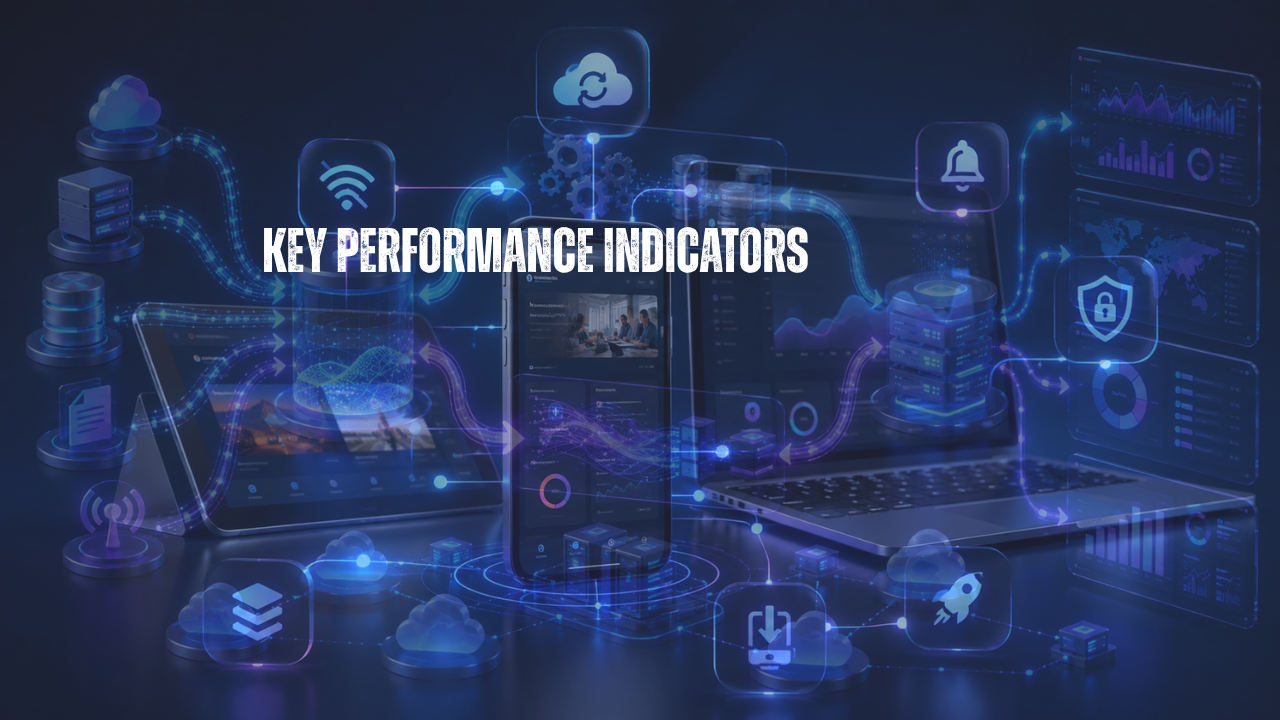
Whatever the size, organisations set goals. Yet if there is no reliable method for measuring progress towards these goals, then planning turns into guesswork and it becomes difficult to enforce accountability. The problem is solved by means of Key Performance Indicators (KPIs), which transform strategic objectives into specific and measurable figures that teams can keep an eye on over time. As long as they are properly designed and used, KPIs enable leaders to see clearly what is working, what is not, and where action is required.
What count as key performance indicators?
A key performance indicator is a measurable figure which shows how well an organisation is achieving a specific objective; such indicators are found at all levels within a business, ranging from overall financial targets to operational standards that are specific to a team.
The word “key” is important in this context. Just because a metric is measured doesn’t mean that it is a KPI. In order to be a KPI, it has to be directly linked to a strategic objective and it must be able to affect decision-making. For instance, counting website visits is a metric, but monitoring the percentage of website visits that result in paying customers is a KPI since it directly links user behaviour to revenue outcomes.
KPIs are generally divided into two categories. Leading indicators relate to the inputs and early-stage activities which can be used to predict future performance, while lagging indicators refer to the outcomes that have already taken place, for example quarterly revenue or annual customer retention rates. In order to achieve effective performance management, both kinds of indicator should be used together so as to obtain a full picture.
How to Define Effective KPIs
It is not enough just to make a list of things that are worth measuring when defining KPIs, since badly chosen KPIs can mislead teams, lead to misaligned incentives, and use up resources without providing any insights. One commonly used approach to developing appropriate KPIs is the SMART criteria, according to which each indicator should be Specific, Measurable, Achievable, Relevant, and Time-bound.
The requirement is that the KPI should clearly state both what is being measured and the reason for it; vague terms such as “improve customer satisfaction” are too general to be tracked in a meaningful way.
Measurable: There needs to be a reliable data source as well as a specific method for working out the value, since otherwise comparisons made over time would not be reliable.
Achievable: The targets linked to the KPIs should be based on realistic performance expectations since setting unreachable benchmarks has a detrimental effect on team motivation and leads to distorted performance evaluations.
Applicable: Every key performance indicator must have a direct link to a strategic priority. If an indicator fails to affect a decision or fails to show progress towards a goal, it contributes noise instead of clarity.
KPIs need specific review periods. Review cycles of a monthly, quarterly, or annual nature establish the routine necessary for regular evaluation and making adjustments.
People who have been trained in data interpretation and requirements analysis are well placed to take the lead in the development of KPIs in corporate environments. The individuals who finish a business analyst course in Chennai acquire the systematic thinking and skills in communicating with stakeholders needed to turn business strategy into practical performance metrics.
Common KPIs Across Business Functions
The various departments use different key performance indicators according to their particular functions and aims, and by knowing which indicators are appropriate for each area the usual error of applying general metrics to the whole organisation can be avoided.
In the field of finance, net profit margin, operating cost ratio, and return on investment are standard financial key performance indicators; they show how efficiently an organisation turns its revenue into sustainable profit.
Sales and Marketing: The figures commonly used include customer acquisition cost, conversion rate, and customer lifetime value; these indicators link marketing expenditure directly to revenue generation.
The cycle time, error rate, and the percentage of on-time deliveries show how reliably processes are being carried out and operational key performance indicators are especially important in manufacturing, logistics, and service delivery situations.
Human Resources: The employee turnover rate, the time it takes to hire someone, and the training completion rate are typical indicators used by HR. These figures monitor the stability of the workforce and the organisation’s ability to develop talent over time.
All of these examples adhere to the same principle—that is, a specific metric, a target figure, a data source, and a review cycle. The format remains consistent even though there are significant variations in the content depending on the function.
Reviewing and Updating KPIs Over Time
KPIs are not set in stone. As the organisation’s priorities change, markets develop and business models evolve, a KPI which was very relevant two years ago might no longer reflect the strategic goals currently in place. By regularly reviewing the KPI framework it is possible to make sure that the organisation is measuring what is actually important at any particular time.
Quarterly reviews are usual when it comes to operational KPIs, whereas strategic KPIs are generally reviewed once a year as part of the overall business planning process. In carrying out these reviews, teams must check if the targets are still suitable, if the data collection methods are accurate, and whether any new priorities call for the addition of new indicators.
For analysts and project managers who are engaged in performance reporting, knowing how to organise these reviews is a practical ability which provides considerable value. A business analyst course held in Chennai generally includes training in performance measurement frameworks together with data analysis and business process design, thus enabling professionals to take a direct part in this type of work.
Conclusion
Key Performance Indicators turn abstract organisational goals into trackable, actionable measures. When defined using clear criteria and aligned to genuine strategic priorities, KPIs give leaders the information they need to make informed decisions at every level of the organisation. The value of a well-designed KPI framework lies not in the number of metrics tracked, but in the quality and relevance of the indicators chosen. Regular review and refinement keep the framework aligned with where the organisation is heading, not just where it has been.