Multimodal generative systems are models capable of understanding more than one kind of input—for example, text, images, audio, or video—and at the same time able to produce content in one or more of those different modalities. It is because of this that applications such as text-to-image generation, speech-to-text transcription, image captioning, and ‘talk to a picture’ type assistants are possible. Should you be enrolled in a generative AI course, a clear understanding of how these systems are structured will assist you in progressing from simply using the tools to designing reliable solutions.
Good architectural design is not merely a matter of the size of the model; it also involves how the different modalities are represented, how they are aligned, how the training objectives are set, and how the system is deployed with reliable latency, quality, and safety.
1) What makes a system “multimodal”?
A multimodal model must solve two core problems:
- Representation refers to the process of transforming text, pixels, and waveforms into a common internal format that the model can reason about.
- That is the process of converting the common format back into an output form (such as words, images, or audio).
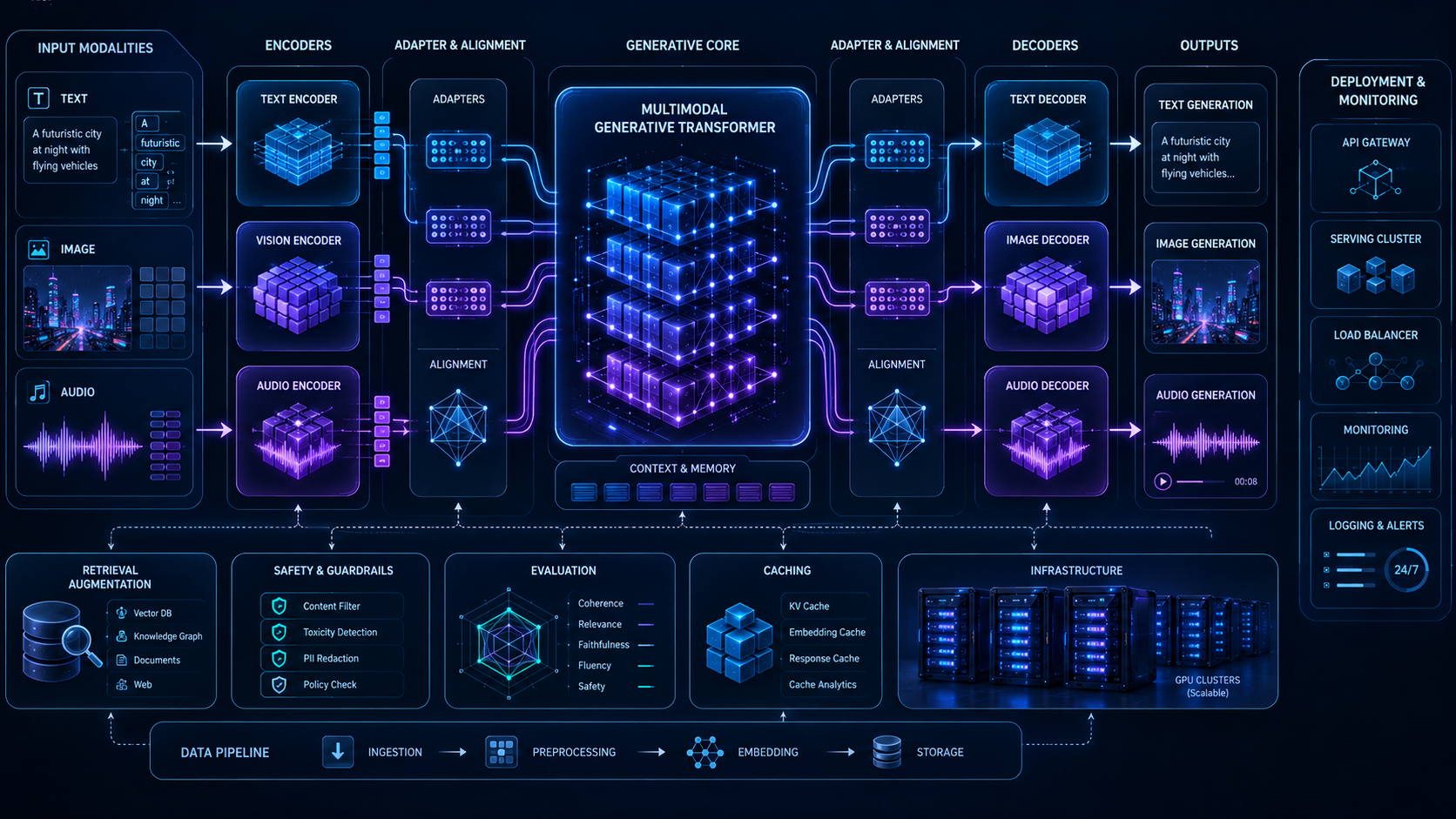
The easiest way to understand this is in terms of “encoders + a generative core + decoders”. The encoders convert each modality into embeddings; the generative core combines them and reasons about them; the decoders then produce the target modality.
Actually, genuine systems include several key elements such as modality adapters, alignment layers, retrieval modules, and safety filters; it is these components that usually decide whether the system can be used in a real-world setting.
2) Core building blocks in a practical architecture
The majority of modern multimodal systems adopt one of these patterns.
Pattern A: Shared token space with a single transformer
In this approach, all kinds of data are turned into tokens. Text is already in tokenised form, while images and audio are converted into individual tokens by means of a codec (in the case of audio) or vector quantisation (for images). One single transformer model is then used to predict the next token, no matter what the modality is. The idea is simple since it involves reusing a single model and having a single decoding process.
The challenge is engineering the tokenisation so that image/audio tokens are compact, informative, and stable. If the tokeniser is weak, the generator will struggle In this setup, the language model functions as the reasoning component. The images and audio are processed by specialised encoders (namely the vision encoder and the speech encoder), and the embeddings obtained from these are transferred into the space of the language model by means of adapter layers. The language model then creates text outputs or generates intermediate representations which a separate decoder then uses to produce the images or audio. or it produces intermediate representations that a separate decoder uses to generate images/audio.
This pattern is popular since it allows you to reuse a capable language model and add modality support without having to retrain all of it from scratch.
Pattern C: Encoder–decoder translation per task
For things such as speech-to-text or image-to-text, the traditional encoder–decoder approach still works: the encoder takes in the input modality and the decoder produces the text. The process is easier to train and to evaluate since there is a clear single-direction objective.
When you want to develop systems for a number of different tasks, it is usual to combine these patterns in a modular way.
3) Data and training: alignment is the hidden bottleneck
The “magic” of multimodality lies mainly in alignment—that is, making sure the model learns to associate certain words with certain visual patterns and certain sounds with certain phonemes or words.
Common training stages include:
- Training on large unimodal corpora—such as text-only, image-only, or audio-only corpora—results in the development of powerful feature extractors.
- The use of multimodal pairing—training on datasets that pair images with captions or audio with transcripts—leads to cross-modal grounding.
- Instruction tuning involves adjusting the behaviour so that it adheres to the user’s intent, generating structured outputs, and refusing unsafe requests.
Loss functions usually combine different objectives: next-token prediction for text, contrastive alignment for image-text matching, reconstruction losses for codecs, and task-specific losses (such as transcription accuracy and caption quality).
A good mental model is that pretraining imparts “knowledge“, pairing provides “grounding”, and instruction tuning leads to “behaviour”. Although people first encounter these ideas in a course on generative AI, they understand them much better when you apply them to specific data pipelines and objectives.
4) Production design: latency, quality, and safety
Multimodal systems can fail in ways that are not apparent when demonstrations are being given. A system ready for use in a production environment generally includes:
- Decide whether the request involves OCR, speech recognition, captioning, or generation.
- For tasks that require facts, retrieve reliable documents rather than simply depending on the model’s memory.
- Guardrails include input filters (which are used to block harmful content), output filters (which serve to reduce unsafe or private data), and policy-aware refusal logic.
- The evaluation system should measure accuracy (using WER for speech-to-text), faithfulness (by assessing the correctness of the captions), image quality metrics, and user-centric scores (based on helpfulness and error rate).
Looking at it from a systems point of view, multitasking workloads are demanding. In such cases you’ll need batching, quantisation, the caching of encoder outputs, and careful planning of GPU usage. When images are being generated, you also have to deal with deterministic seed handling in order to ensure reproducibility and provide reasonable default values for resolution and aspect ratios.
After all, interpretability is important; it is essential to record the intermediate decisions of the model, to keep track of which modalities had an influence on a given answer, and to store anonymised examples of failures.
Conclusion
Multimodal generative systems function only when the architecture gives each modality due attention: this involves using powerful encoders, ensuring careful alignment, selecting an appropriate generative core, and including production layers which handle latency and safety. The superior designs are modular in nature so that you can replace the encoders, add retrieval capabilities, and extend the system to new tasks without having to rebuild it all from scratch. Should your aim be to move beyond simply using tools and instead to design reliable applications, a generative AI course is most worthwhile when it places a strong emphasis on these architectural decisions—since it is the architecture that transforms a dazzling demonstration into a trustworthy system.