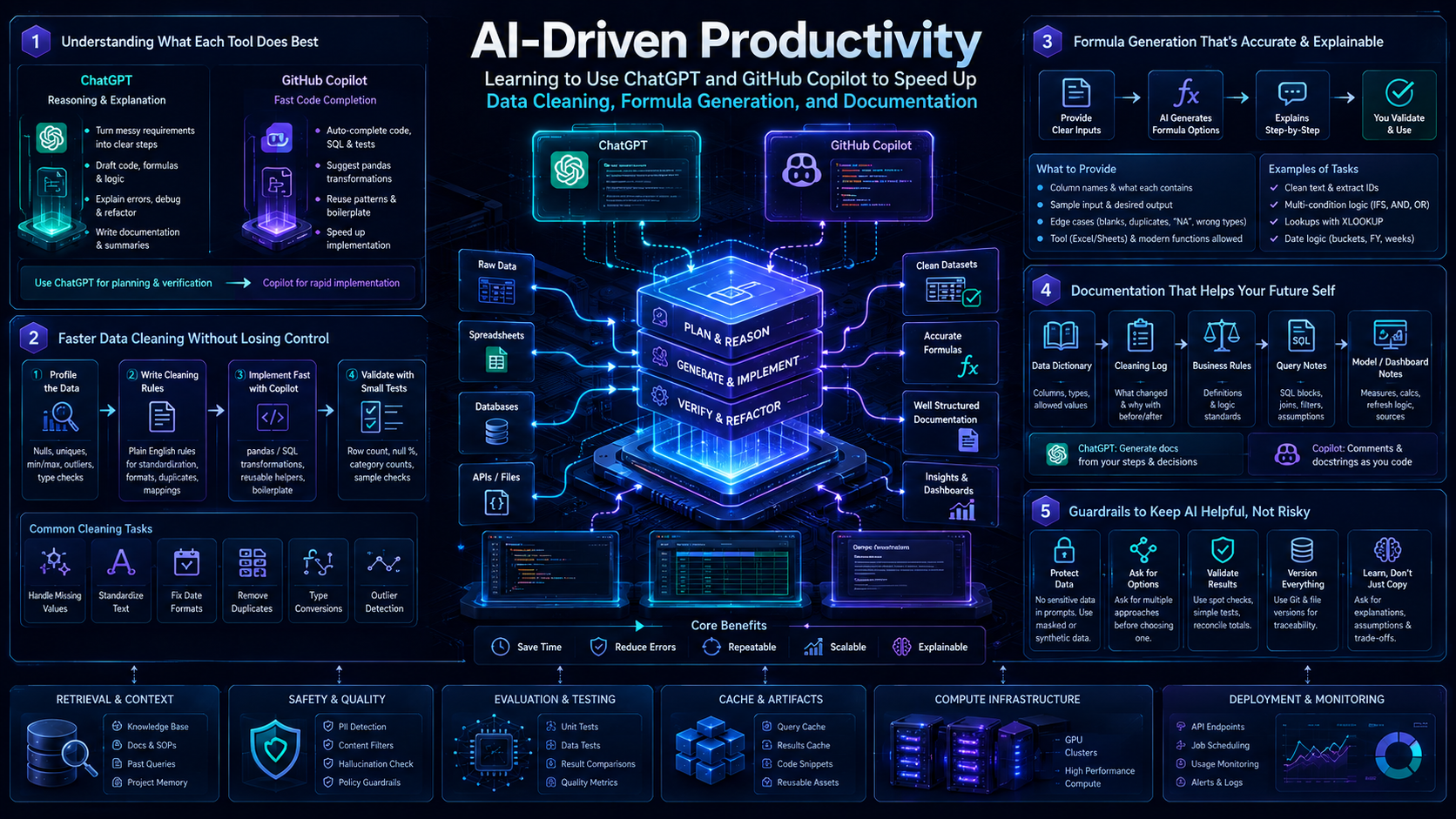
AI assistants are not any longer optional tools for analysts since they can make a real difference in the time spent on repetitive tasks. Proper use of ChatGPT enables you to work through logical problems, produce drafts and check your assumptions, while GitHub Copilot speeds up the process of coding within your editor. The two of them can increase the speed at which three common tasks are carried out: data cleaning, formula generation, and documentation. This workflow can also help learners who are doing data analytics coaching in Bangalore to reduce the time it takes to get from ‘learning a concept’ to ‘using it in real projects’.
1) Understanding What Each Tool Does Best
ChatGPT: reasoning and explanation support
ChatGPT is useful when you need to:
- Turn the disorganised requirements into clear steps (for example, ‘clean these columns, standardise the date formats, remove the duplicates’).
- Formulate some example code or formulas in light of the information you have.
- Give an explanation of why a query fails, clarify what an error message means, or describe how to refactor a solution.
- Write documentation, validation notes, and project summaries.
GitHub Copilot: fast code completion in your IDE
Copilot performs at its best when you are actually writing code in tools such as VS Code. It is able to:
- Auto-complete functions, loops, SQL queries, and test cases.
- Offer ideas for pandas transformations or reusable helpers.
- When you already know the direction you want to go, just cut down on boilerplate in order to gain speed.
The main idea is to use ChatGPT for planning and verifying, and Copilot for rapid implementation.
2) Faster Data Cleaning Without Losing Control
It is during the data cleaning process that analysts spend the majority of their time—dealing with missing values, inconsistent categories, defective date formats, and duplicate rows. Although AI can help to speed things up, this is only possible if you maintain strong checkpoints.
A practical workflow you can follow
- Profile the data first
- Request from ChatGPT a profiling checklist consisting of null counts, the number of unique values, the minimum and maximum values, the method for outlier detection, and type checks. Then execute this checklist in your tool (this could be Excel, Python, SQL, or Power BI).
- Write cleaning rules in plain English
- Remove extra spaces, standardise Bengaluru/Bangalore, replace minus signs with null values, interpret the dates in the format dd-mm-yyyy and remove duplicates based on email and date.
- ChatGPT is able to convert them into structured steps and propose edge cases that you might overlook.
- Implement quickly with Copilot
- When you write pandas or SQL transformations, Copilot can help with common tasks. It can fill in patterns like fillna, str.strip, astype, to_datetime, drop_duplicates, and cleaning functions you can use again.
- Validate with small tests
- Avoid saying “trust and ship” and include the following checks: the row count before and after, the percent null change, the category counts, and comparisons of samples.
When you’re getting data analytics coaching in Bangalore, make it a point to turn each cleaning task into a reusable template by following this sequence: profiling, then creating a rule list, followed by the transformations and finally validation. It’s that structure which enables your work to be scalable.
3) Formula Generation That’s Accurate and Explainable
Excel and Google Sheets formulas are powerful but time-consuming to build and debug—especially nested logic, lookups, and dynamic arrays. AI can help you draft formulas faster, but accuracy depends on how you prompt.
What to provide to get good formulas
When you ask ChatGPT for a formula, include:
- The column names and what each contains
- A sample input and desired output
- Edge cases (blank cells, duplicates, “NA”, wrong types)
- Your tool (Excel vs Sheets) and whether you can use modern functions (XLOOKUP, LET)
Examples of tasks AI can speed up
- Cleaning text: removing extra spaces, standardising case, extracting IDs
- Conditional logic: multi-condition categorisation using IFS, AND, OR
- Lookups: replacing complex INDEX/MATCH chains with XLOOKUP
- Date logic: month buckets, financial year grouping, week numbers
When you’ve worked out a formula, request that ChatGPT explains it step by step using simple language. This is important for use in interviews, when handing the work to a team, and for reducing any confusion that may arise when you look at the file again.
4) Documentation That Actually Helps Your Future Self
Most analysts either omit the documentation or prepare it at the end—in either case there is the need for rework. Although AI makes it easier to produce documentation continuously, it has to be specific to your dataset and logic.
What to document during analytics work
- Data dictionary: column meanings, data types, allowed values
- Cleaning log: what you changed and why (with before/after examples)
- Definitions of business rules (for example, “active user”, “qualified lead”, “churned customer”)
- Query notes: what each SQL block does, key joins, and filters
- Model or dashboard notes: measures, calculated columns, refresh logic
ChatGPT is able to produce these sections rapidly provided that you give it your steps and decisions. Copilot can assist you with code comments and docstrings as you are writing functions. In the case of teams in Bangalore that are running data analytics coaching, thorough documentation is usually what makes the difference between ‘a project done for learning’ and ‘a portfolio project that looks professional’.
5) Guardrails to Keep AI Helpful, Not Risky
AI speeds up work, but only if you avoid common mistakes:
- Don’t put sensitive data into public prompts; instead use masked examples or synthetic rows.
- When logic is uncertain, ask for several options (for example, two formulas or two SQL methods).
- Check the results using spot checks and simple tests.
- Keep a record of versions (use Git for code and file versions for spreadsheets).
- Use AI to learn, not just copy. Ask for explanations, assumptions, and trade-offs.
Conclusion
You can increase your productivity when using ChatGPT and GitHub Copilot by following a structured approach: plan out the logic, produce draft versions, implement them quickly, and then verify them carefully. The real benefit isn’t automation but rather faster iteration—this involves cleaning data using repeatable rules, creating formulas with a clearer intent, and documenting your decisions while they are still fresh. Should your aim be to become job-ready by receiving data analytics coaching in Bangalore, carrying out this AI-assisted workflow will enable you to produce cleaner results, work more quickly, and be confident when explaining your work.